Type: Personal Essay
Writer: Jahnavi Pradeep
On February 13, the coincidental eve of Valentine’s Day, I have a brief affair with Vembar, my maternal native. I am mid road trip with a friend, and that morning, we peer over our Google Map squiggle that runs across the southeastern boundary of the Indian subcontinent to connect our current location, Rameshwaram, to our port of arrival, Kanyakumari. The haunting task at hand is to find a decent joint to lunch at along the way, and we unsuccessfully zoom into the map in hopes of unearthing the tried and tested A2B joint. But the restaurants are all unfamiliarly local and we lack the knowledge to make sound judgements. Scrolling down the snaking route, we dejectedly watch the dots unfold into the convoluted names of strange Tamil townships, unpronounceable and foodless. Of them, our attention is suddenly caught by a familiar anomaly slightly off route: two simple syllables – Vem/bar – are tucked cleanly along the coast, almost disappearing into the Indian Ocean. It is my mother’s ancestral town.
Let’s go, my friend suggests, fascinated by our discovery. Not overtly attached to the idea but finding it a fun proposition, I oblige. Lunch is replaced with Vembar, and the pitstop pilgrimage is a satiating meal in its own right: an instant scenic trump card in our road trip exploration. Vembar is a beautiful ghost town. We zigzag through a labyrinth of narrow streets that have been emptied out by the afternoon heat until we arrive at the expanse of the ocean; an endless blue necklaced by an array of colorful fishing boats bobbing their heads against the current of the waves. We park the car and step out, armed with cameras dangling around our necks and sunglasses propped on our heads. We are in true tourist element and I feel like a trespasser. The sand settles into the gap between my slippers and the arches of my heels as I shuffle my feet in formal discomfort.
Vembar is unfamiliar to me in all facets except nomenclature. My mother’s maiden name was Sreevidya V.V, and her two-pronged surname is a condensation of my grandfather’s name and her paternal native rolled into one: V.V for Vedantachar Vembar. Oddly enough, Vedantachar has never been to Vembar himself, his own life charted by migratory patterns across Karnataka that never take him back to his roots in Tamil Nadu. Even after his death three years ago, his ashes are scattered in Srirangapatna, a two hour drive from his house in Bangalore. This is home as he knows it, as my mother knows it, and as I know it. V.V are coordinates to a long forgotten geography.
When my mother gets married to my father, she swaps out V.V for a brand new shining surname – Pradeep – her husband’s given name. I share this surname with her, and our family is an island of four floating on its own. We have lived most of our lives landlocked in the metropolis of Bangalore, where my parents have fostered a nuclear household threatening to explode with the slightest contact of any relatives. Weighed down by childhoods of too many siblings and overbearing conjoined families, they both prefer the solitude of just the Pradeeps. I have grown up maintaining a process of defamiliarizing the familiar and resorting to an exclusive sense of family and home. Pradeep is an ironically simple last name that I am increasingly detached from. It is my mother I want to find, and V.V. is a ghost of her past that I suddenly find myself chasing.
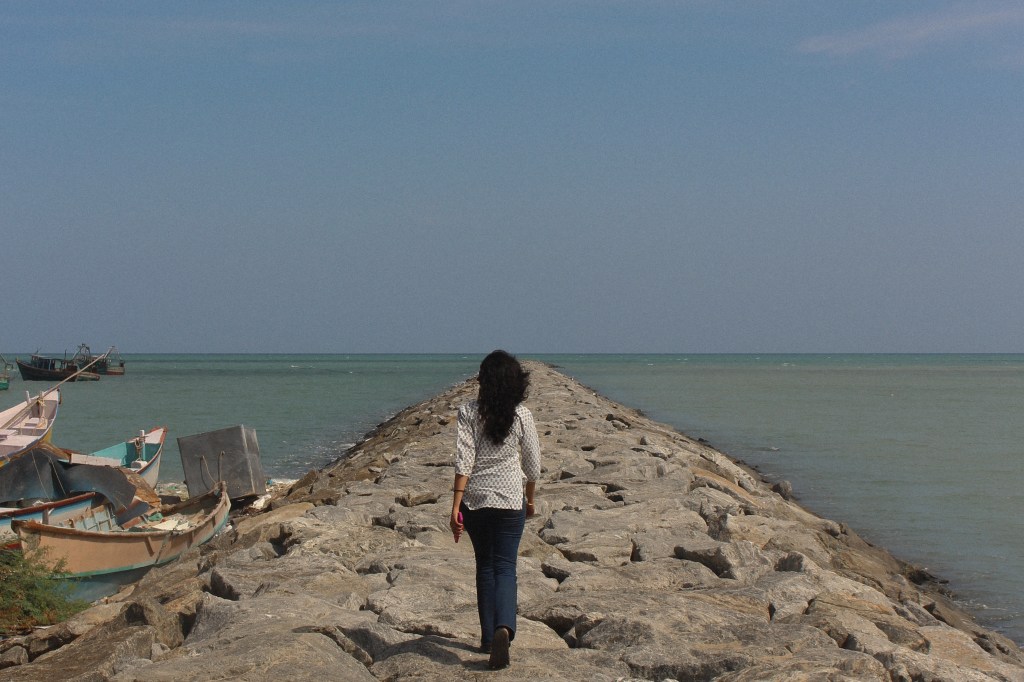
I attempt to run down the jagged pier cutting between the docked boats of Vembar to disappear into the horizon that sparkles like a treasure pot at the end of a rainbow. Unwieldy camera in hand, I am slowed down by the hodge-podge rocks haphazardly arranged, and my feet turn sloth-like as I struggle from stone to stone. One sprawls across the center in an amoeba-esque blob marbled with black and white swirls that mold the rock into the night sky, a thin sheen of stars glittering over its surface. An inky darkness spills from its gaps, reaching toward the peripherals of the constellation of whitish-brown toffee stones to extend the pier into a galaxy disappearing into the distance.
My legs shiver in the mild fear that I will slip and tumble down into the water before I reach the end. I pause to catch my breath, wiping the sweat sprouting from my forehead and around my nostrils, and turn to see how far I have moved from the coast. When I get to the end, I find myself having traced backward. I am a child again. I crouch at the end of the pier and wait for the ocean to wrap its arms around me and swallow me into its belly. I indulge in the fantasy of wanting to imagine myself as belonging here. For the ocean to rebirth me so Vembar is mine beyond just my mother’s long lost surname.
We sit in silence at the junction where pier meets ocean. Here, I am my mother’s daughter. I project against the canvas of blue a place where I see my mother as Sreevidya V.V. I wonder what she might have been like here. Would the coast teach her to be free? To be bold? The ocean quietly bobs in nods and a piping of gold outlines the ripples of waves, each unwrapping a spill of diamond-like sparkles in their folds as they move toward the coast like a gift. With each ebb and flow, a ritualistic spray of saline water splashes against my feet. It washes between my toes to sting the unhealed scabs and travels upwards through my body to dissolve the unease lodged in my throat. I lick my lips to taste the salt.
I want to thank my friend for bringing me to Vembar but I am embarrassed. I cannot help but think of what he has told me about his own family, a happy and extending sprawl of people scattered across the country, all of whom he talks about with animated familiarity. I want to imagine my own family like this. I close my eyes and pretend to know what my relatives here might look like. How they might laugh with each other as they board their boats in the morning, nostrils mildly flaring the way my mother’s does when she giggles at her own silly jokes. How my grandfather might have had a house on one of these street corners, his verandah filling with sand as my brother and I run up and down to the beach with water dripping down our backs and smiles dancing across our tanned faces. I indulge in the fantasy of wanting to imagine myself as belonging here. Of what might happen if I were to approach a stranger on our way back to the car. Perhaps she will invite us over for a scrumptious five-course lunch in her kitchen. And perhaps she and my mother will be related.
The fantasies hustle past as if running away from one another through packed crowds and threaten to disappear. When I open my eyes, we are alone with the sea. Above us, the clouds hang like pearl-white cotton candy on the verge of melting Vembar into a sticky sweet residue that will later paste itself to my skin and trickle down through my scalp to enter my brain, where it will remain lodged well after we have driven into the evening and away from the coastal geography of this strange encounter. I trace the sound of the two syllables that drawl out into a space of longing: Vem/Bar.
 Jp
Jp 